




References
Summary Molecular data play a key role in phylogenetic and molecular evolution inferences. Mammalian genomics and systematics provides us with a clear example, with several open evolutionary questions now able to be answered. However, molecular studies have until present used only a handful of standard markers and have not attempted to utilise the information contained within the increasingly large pool of mammalian genome sequences. The identification and utilisation of potentially new informative markers from this comparative genomics pool can help to further resolve the mammalian phylogenetic tree, and better understand the evolutionary dynamics of genes.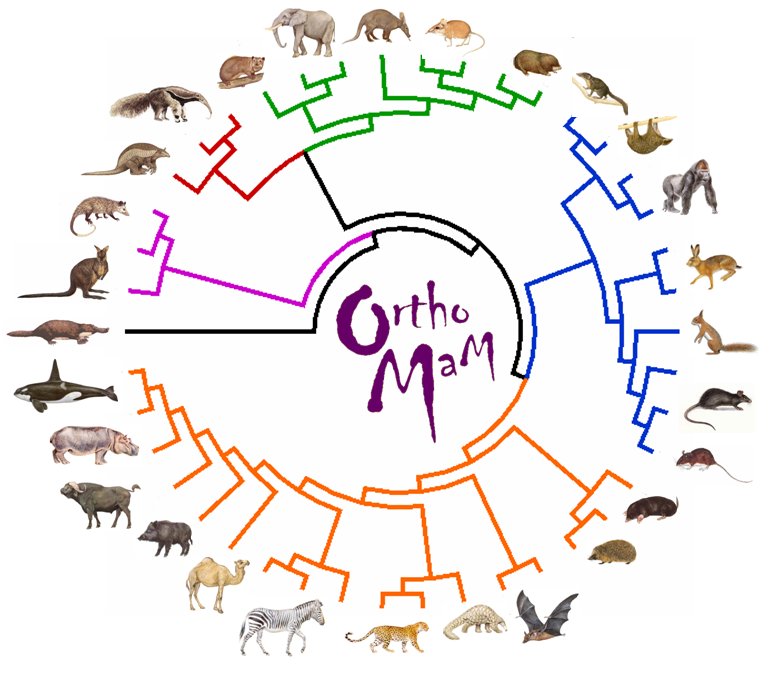
Description The EnsEMBL database was used to decide on a set of 1-to-1 orthologous markers from those mammalian genomes available. Exons of reasonable length for further amplification from genomic DNA and sequencing in additional species were then selected. For phylogenomic purposes, CoDing Sequences (CDSs) were also collected. The phylogenetic utility and the evolutionary characteristics of these candidate markers were then evaluated using a homemade bioinformatics pipeline. The resulting OrthoMaM database can be interrogated through this website.
The current OrthoMaM release (v6) is based on EnsEMBL v56. It now includes 6,056 exons and 12,777 CDS alignments for up to 36 species.
If you use OrthoMam, please cite:The following works have used and cited OrthoMaM
- OrthoMaM: A database of orthologous genomic markers for placental mammal phylogenetics. Ranwez V., Delsuc F., Ranwez S., Belkhir K., Tilak M. & Douzery E. J. P. BMC Evolutionary Biology 7 : 241, 2007.
- Contrasting GC-content dynamics across 33 mammalian genomes: Relationship with life-history traits and chromosome sizes. Romiguier J, Ranwez V, Douzery EJP, Galtier N Genome Research 20(8):1001-1009, 2010
- Developing a series of conservative anchor markers and their application to phylogenomics of Laurasiatherian mammals Zhou X., Xu S., Zhang P., Yang G. Molecular Ecology Resources, 2010
- SuperTriplets: a triplet-based supertree approach to phylogenomics. Ranwez V, Criscuolo A, Douzery EJP BioInformatics 26(12):i115-i123, 2010
- An Evolutionary Genome Scan for Longevity-Related Natural Selection in Mammals. Jobson RW, Nabholz B, Galtier N Mol. Biol. Evol. 27(4):840-847, 2010
- The expansion of amino-acid repeats is not associated to adaptive evolution in mammalian genes. Cruz F, Roux J, Robinson-Rechavi M BMC Genomics 10:619, 2009
- Covariation of Branch Lengths in Phylogenies of Functionally Related Genes. Li WLS, Rodrigo AG Plos One 4(12) e8487, 2009
- Reviews in comparative genomic research based on orthologs. Pan Z-X, Xu D, Zhang J-B, Lin F, Wu B-J, Liu H-L Hereditas (Beijing) 31:457-463, 2009
- GC-biased gene conversion promotes the fixation of deleterious amino acid changes in primates. Galtier N, Duret L, Glémin S, Ranwez V. Trends Genet. 25:1-5, 2009
- PhyloExplorer: a web server to validate, explore and query phylogenetic trees. Ranwez V, Clairon N, Delsuc F, Pourali S, Auberval N, Diser S, Berry V. BMC Evol. Biol. 9:108, 2009
- Computer-assisted automatic classifications, storage, queries and functional assignments of orthologs and in-paralogs proteins.Thybert D, Avner S, Lucchetti-Miganeh C, Barloy-Hubler F. Curr. Bioinformatics 4:129-140, 2009
- IDEA: Interactive Display for Evolutionary Analyses. Egan A, Mahurkar A, Crabtree J, Badger JH, Carlton JM, Silva JC. BMC Bioinformatics 9:524, 2008
- PhySIC_IST: cleaning source trees to infer more informative supertrees. Scornavacca C, Berry V, Lefort V, Douzery EJP, Ranwez V. BMC BioInformatics 9:413, 2008